

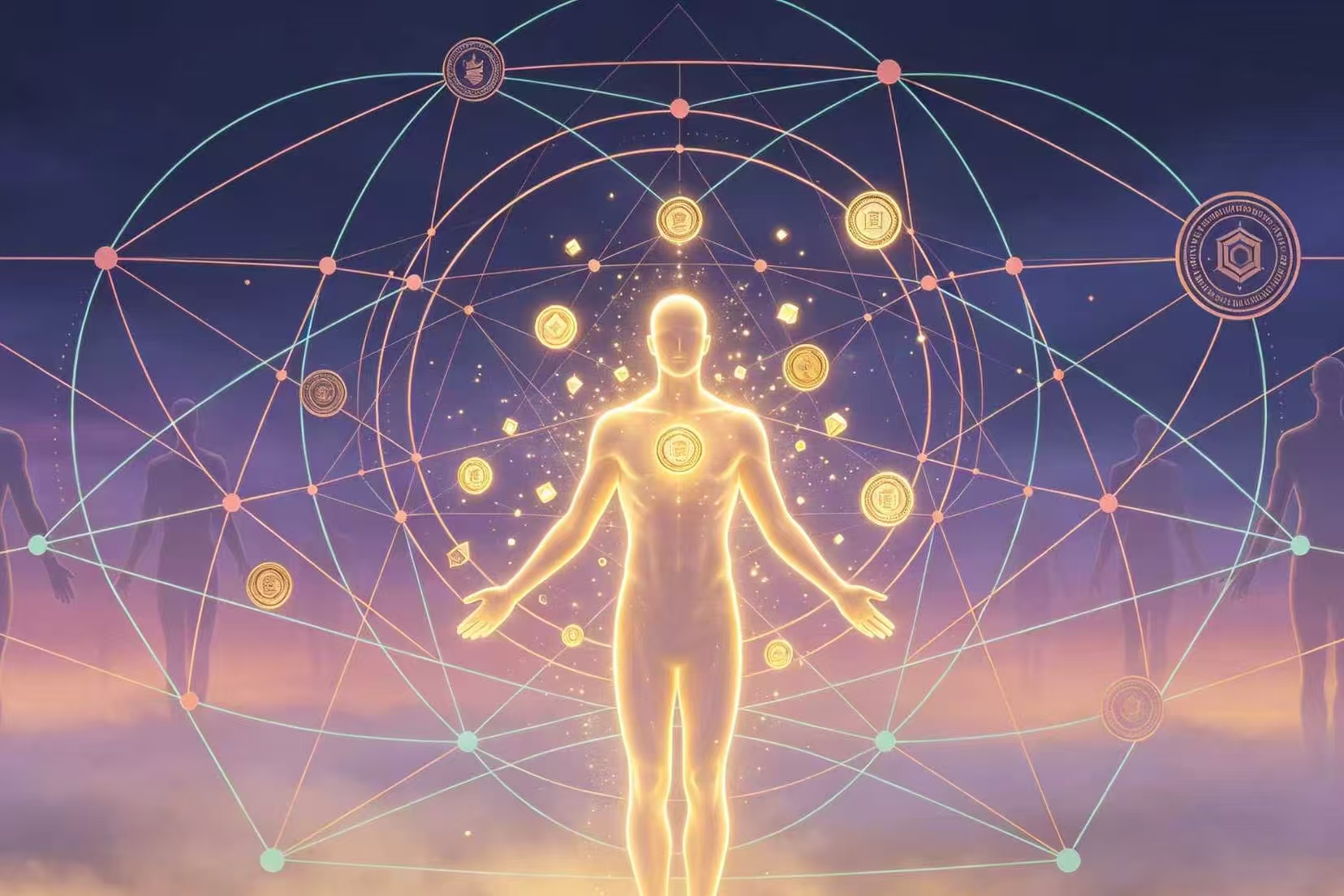
In the digital realm, identity is fluid. You can be anyone, create multiple accounts, and discard reputations at will. While this freedom has its virtues, it also makes trust difficult to establish. How do you know the person you are interacting with online is who they claim to be? How can you trust that they have the skills they profess, the credentials they list, or the history they describe? In 2022, Ethereum co-founder Vitalik Buterin and others proposed a conceptual framework for a “Decentralized Society” (DeSoc) built around a new primitive: Soulbound Tokens (SBTs). These non-transferable digital tokens, tied to a specific “Soul” (an identity or wallet), could fundamentally change how we encode, verify, and trust identity and reputation in the digital age, with profound implications for how we live, work, and organize.
Unlike traditional cryptocurrencies or NFTs, which are designed to be freely traded, Soulbound Tokens are permanently attached to their owner. They cannot be sold or transferred to another person. This non-transferability is precisely what makes them useful as containers for identity and reputation. A university degree, a professional certification, a medical license, a work history, a membership in a community, a criminal record—these are all aspects of a person’s identity that should not be buyable or sellable. SBTs provide a way to issue these credentials as verifiable, tamper-proof tokens on a blockchain, held in a personal wallet that represents one’s “Soul.” An employer can instantly verify a job candidate’s degree by checking the issuer’s cryptographic signature on the SBT, without needing to contact the university. A DAO can require that a voting member hold an SBT proving attendance at a certain number of in-person events, preventing sybil attacks where one person controls many wallets.
The vision extends far beyond simple credentials. A rich web of SBTs, issued by different institutions and peers, can form a composite portrait of an individual’s character and capabilities. Over time, a “Soul” accumulates a diverse collection of tokens that attest to education, employment, peer reviews, community contributions, and even personal milestones. This creates a form of programmable reputation that is owned by the individual but verified by a network of trust relationships. Crucially, this reputation is not a single, algorithmic score assigned by a central authority, but a transparent constellation of claims that can be weighted and interpreted differently by different applications. A DeFi protocol might look at your on-chain loan repayment SBTs, while an art collective might care about your creative contributions and community SBTs. You choose which tokens to present in which context, often using zero-knowledge proofs to reveal only the minimum necessary information—for instance, proving you are a licensed doctor without revealing your full name or place of work.
The implications for creative living and community building are profound. Imagine a world where your contributions to open-source projects, your volunteer work, and your artistic collaborations are all documented as SBTs. This creates a rich, verifiable portfolio of your life’s work that travels with you, independent of any platform or resume format. It enables new forms of community governance where voting power is based on demonstrated commitment and expertise rather than token wealth. It allows for the creation of “soulbound” communities where membership is based on genuine shared experience and verified identity, fostering deeper trust and collaboration. For artists and creators, SBTs can serve as a living archive of their journey, with early collectors, collaborators, and mentors permanently linked to their creative Soul.
Inspiration for the Decentralized Society comes from recognizing the limitations of purely financialized models of blockchain interaction. Current DAOs often suffer from plutocracy, where governance power is bought by the highest bidder. Current NFT markets focus heavily on speculation and flipping rather than long-term cultural value. SBTs offer a corrective by encoding non-financial aspects of human identity into the Web3 infrastructure. They allow us to represent the things that truly matter in human relationships—trust, loyalty, skill, experience—in a digital format that is secure and verifiable. The decentralized society is not a utopian vision of replacing offline life; it is a practical proposal for building a richer, more human layer on top of the existing internet.
Challenges are significant and must be approached with care. The permanent, non-transferable nature of SBTs raises privacy concerns. A Soul that accumulates negative tokens—such as a criminal record or a defaulted loan—could face permanent discrimination. Recovery of a Soul in case of wallet loss is a difficult problem; the proposal suggests a social recovery model where a set of guardians can collectively help regenerate a Soul, but this adds complexity. There is also the risk of a dystopian surveillance state if governments or powerful institutions issue SBTs without consent. The decentralized society vision explicitly advocates for self-issuance and community-based verification as counterweights to institutional overreach, but the balance is delicate.
Despite these challenges, the concept of Soulbound Tokens has ignited a global conversation among developers, economists, and social thinkers. Projects are already experimenting with SBTs for proof of attendance (POAPs), community membership, and verifiable credentials. The move toward a decentralized society is not a single technological upgrade but a slow, iterative process of building new social institutions on distributed ledgers. It asks a fundamental question: what if the internet, rather than eroding trust, became the most trustworthy environment humanity has ever built? For those seeking a more meaningful, connected, and equitable digital life, the path toward a decentralized society of Souls is one of the most intellectually and creatively exciting frontiers in the blockchain space.