

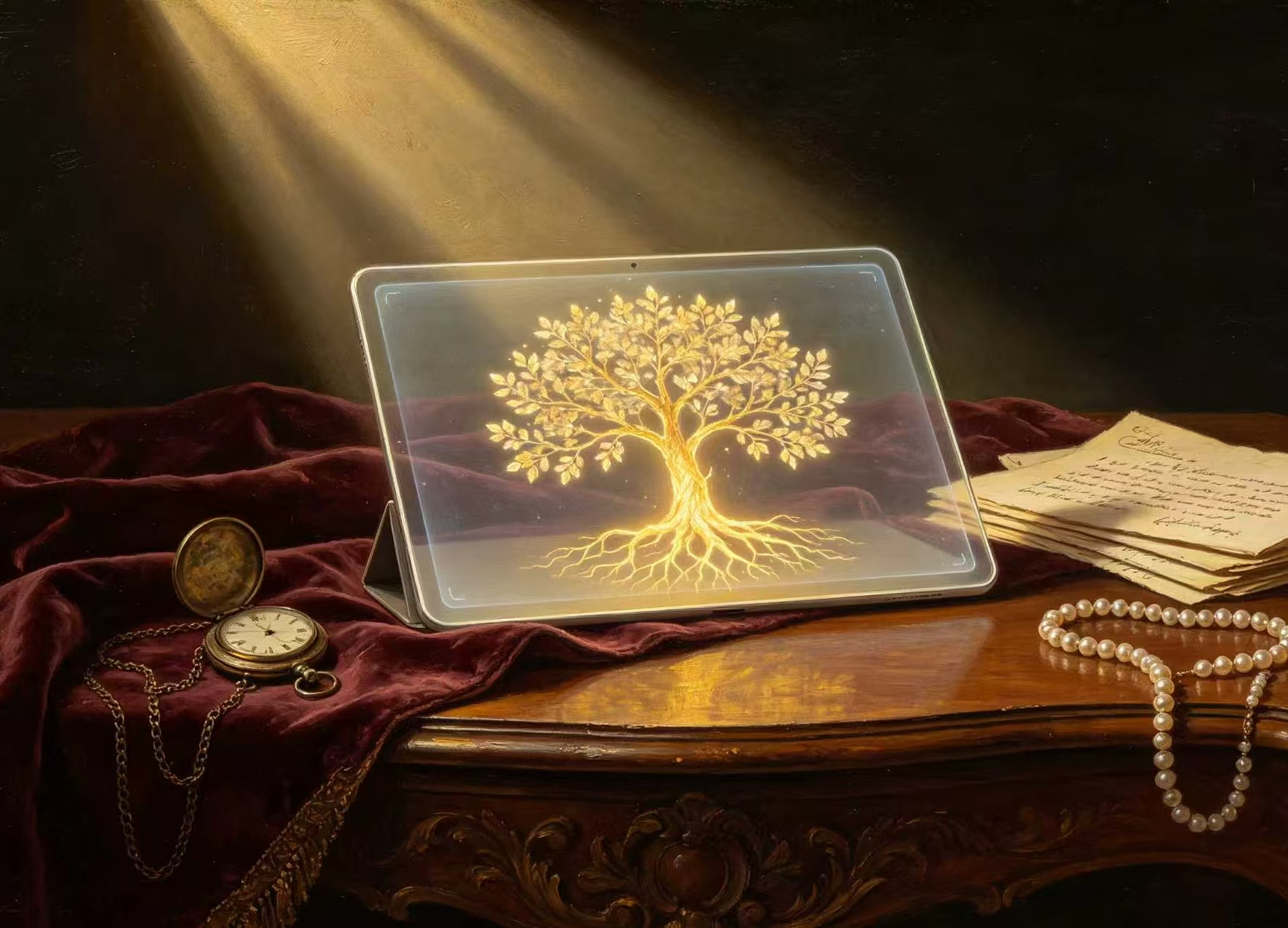
Throughout human history, families have passed down heirlooms—jewelry, letters, photographs, paintings, and furniture—as tangible links to their ancestors. These objects carry stories, values, and identity across time. But in an increasingly digital world, many of our most meaningful creations and memories exist as fragile files on hard drives, cloud servers, and social media accounts that may become inaccessible or disappear within a generation. Blockchain technology is introducing the concept of digital heirlooms: cryptographically preserved assets and records that can be transmitted across centuries with their provenance, meaning, and emotional weight intact.
The foundation of a digital heirloom is the non-fungible token, or NFT. While NFTs have been popularized as speculative art investments, their deeper cultural utility lies in their permanence and verifiability. An artist can mint a digital painting not just as a collectible, but as a letter to their grandchildren, encoded with metadata that includes a personal message, the date of creation, and the story behind the work. Because the blockchain is an immutable ledger, that message and that artwork will remain accessible and verifiable as long as the underlying network exists. Unlike a photograph stored on a smartphone that can be lost or corrupted, an NFT lives on a decentralized network of thousands of nodes. It is not dependent on a single company’s server or a platform’s continued existence.
The concept extends far beyond visual art. A writer could tokenize an unpublished manuscript, creating a digital heirloom that can be held by family members and only revealed at a certain date through a time-locked smart contract. A musician could leave a vault of unreleased recordings as NFTs, with royalties split among descendants. A filmmaker could mint a private documentary of a family reunion, preserving the voices and faces of elders for generations yet unborn. These tokens are not just files; they are wrapped in programmable logic that can dictate how they are accessed, shared, or transferred. They can be designed to unlock on a grandchild’s eighteenth birthday, or to reveal additional content after the original creator’s passing, verified by decentralized oracles.
The emotional and cultural significance of such heirlooms is profound. Traditional physical heirlooms are vulnerable to fire, theft, and decay. Digital heirlooms, properly secured, are resistant to physical destruction. A family fleeing a war zone cannot carry a chest of antique silverware, but they can carry a seed phrase that preserves a library of ancestral art, stories, and records. This is not hypothetical; humanitarian organizations are already exploring blockchain-based tools to help refugees preserve identity documents and cultural heritage. In this sense, digital heirlooms are a form of cultural resilience, ensuring that the stories of families and communities survive even when their physical homes do not.
From a wealth management perspective, digital heirlooms also represent a new class of intergenerational asset. Unlike traditional investments, which are often liquidated and divided, an NFT can be held collectively by a family, its value appreciating not just financially but also emotionally. Smart contracts can be structured to distribute fractional ownership among many heirs, or to grant viewing rights to all while keeping the underlying asset intact. A family DAO could be established to manage a growing collection of digital heirlooms, with younger generations gradually taking over governance. This introduces a fascinating convergence of estate planning and decentralized technology.
Artists and creators are at the forefront of this movement. Several prominent digital artists have spoken about their intention to create works specifically as heirlooms—pieces imbued with deep personal narrative, meant to be held by family lines rather than traded on speculative markets. The artist Trevor Jones, for example, has created works that blend his personal story with his digital art, encoding layers of meaning that reward long-term contemplation. By minting these on blockchain, he ensures that the works’ authenticity and story cannot be altered or erased. They become fixed points in a family’s cultural history.
The technical infrastructure for digital heirlooms is still maturing. Long-term storage of the actual media files requires decentralized storage solutions like Arweave or IPFS, which are designed for permanence. The user experience of accessing and displaying these heirlooms needs to become as simple as opening a photo album. Wallet recovery mechanisms must be robust enough to survive generations, perhaps through social recovery or institutional custody solutions. Yet the direction is clear. Just as we have preserved ancient texts on parchment and stone, we are learning to preserve our digital legacy on blockchains.
The idea of digital heirlooms invites us to think about what we create today and what it might mean to those who come after us. A tweet, a digital painting, a video of a parent singing a lullaby—these are the artifacts of our age. By anchoring them to an immutable ledger, we give them the permanence they deserve. We turn ephemeral digital files into enduring treasures. In doing so, we bridge the gap between the ancestral tradition of the heirloom and the boundless creativity of the digital age. The past, present, and future can now coexist on a single, unbroken chain.