

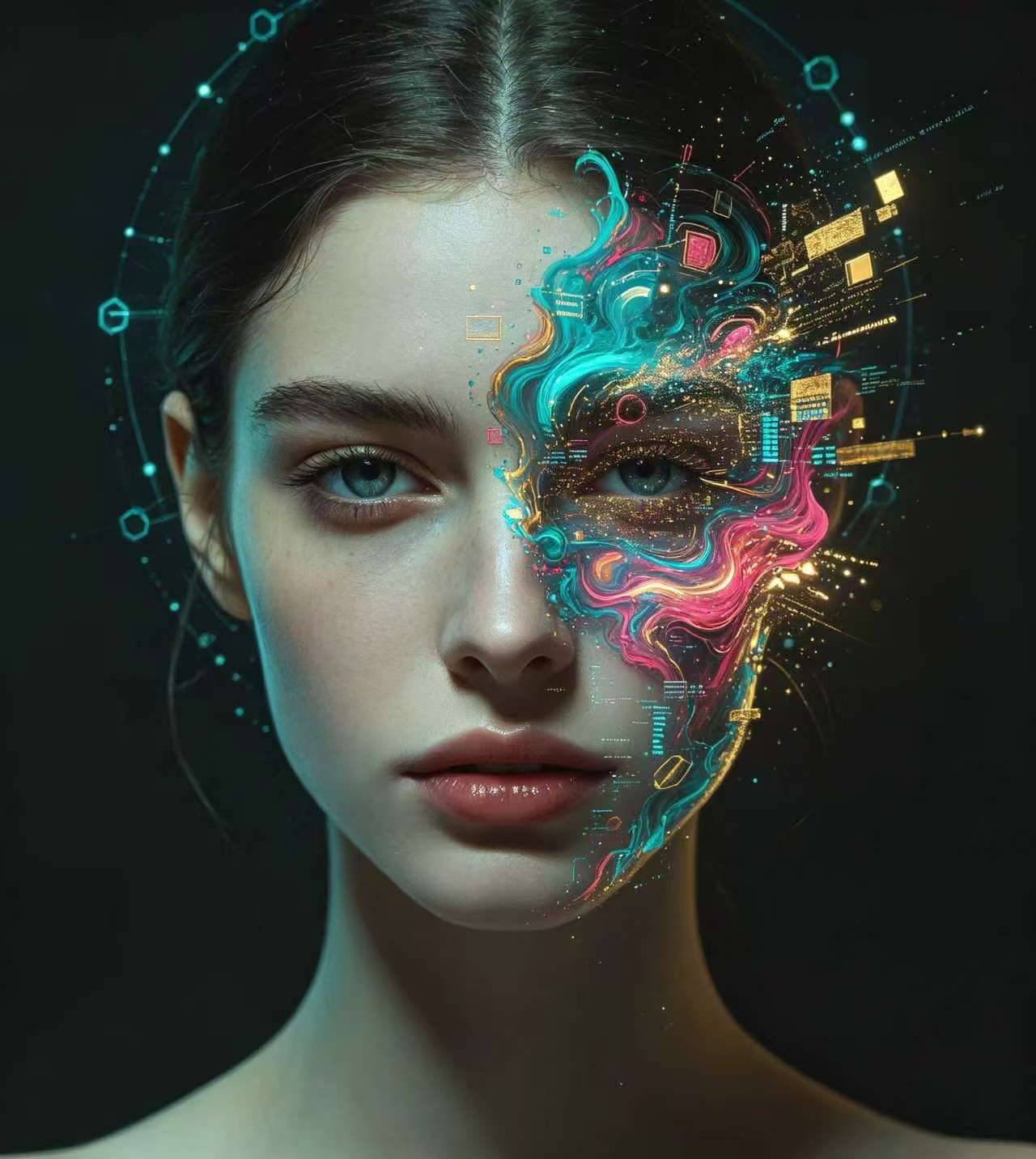
In a sunlit studio cluttered with sketches, screens, and stacks of generative art books, an artist named Elara Voss (a fictional composite representing a new wave of digital creators) is building a portrait of humanity that no single museum could contain. Her medium is not paint or clay, but code—algorithms that interact with the Ethereum blockchain and artificial intelligence models to create evolving, self-portraits of her audience. Through her work, she is not just making art; she is asking fundamental questions about who we are in the digital age, and blockchain is both her canvas and her archive.
Elara’s signature project, “Soul Mirrors,” is a series of interactive NFTs that change over time based on the owner’s on-chain activity and their interactions with an embedded AI. When a collector purchases a Soul Mirror, they receive a dynamic token that initially shows an abstract, shimmering field of color. Over months, the AI, trained on a model of psychological archetypes, analyzes the collector’s public wallet history, governance votes, and even the metadata of the art they hold. It does not access private data; it reads the publicly visible footprint of a digital life. The Soul Mirror then evolves, generating a unique, ever-shifting visual representation of that person’s on-chain identity—a blend of geometric shapes, color palettes, and symbolic motifs that the AI associates with their behavior. The result is not a literal portrait, but an algorithmic interpretation of a digital soul, owned entirely by the subject and verifiable on the blockchain.
“I’m fascinated by the gap between who we think we are and what our data reveals,” Elara explains in a talk at a Lisbon digital art festival. “The blockchain is a public record of action. It’s a mirror of our economic selves, our social selves, our voting selves. I want to turn that mirror into art—to make people confront their digital shadow in a beautiful, unsettling, and ultimately empowering way.” Her work has resonated deeply in a world grappling with online identity, privacy, and authenticity. Collectors report feeling a strange intimacy with their Soul Mirrors, as if the artwork knows them in a way that no static painting ever could.
Elara’s journey to this intersection of art, blockchain, and AI is itself a story of creative liberation. Trained as a traditional painter, she spent years in the gallery circuit, frustrated by gatekeepers and the slow pace of the art market. Discovering Ethereum in 2017, she saw a way to bypass intermediaries and connect directly with an audience that understood digital culture. She began minting early generative works on platforms like Art Blocks, finding a community that valued code as craft. But it was the integration of AI models—run in a decentralized manner through compute networks—that unlocked her current practice. “I can now create living artworks that are co-authored by the collector and the machine. The blockchain anchors the authorship, the AI provides the evolution. It’s a triangle of creation,” she says.
Her creative living model is a blueprint for many emerging digital artists. Elara earns a living through primary sales of her NFTs, which are collected by a global community of patrons. Smart contracts ensure she receives royalties on secondary sales, providing ongoing income as her career grows. She is also a member of a DAO for digital artists, where she participates in collective exhibitions and receives grants for experimental work. Her studio is wherever she has her laptop and a hardware wallet; she has worked from Berlin, Medellín, and a small village in the Swiss Alps. This portability allows her to draw inspiration from diverse cultures and to live a life aligned with her values of freedom and continuous learning.
The artistic impact of her work extends beyond the blockchain community. Major art publications have featured “Soul Mirrors,” and a well-known contemporary art museum recently acquired a piece for its permanent collection, displaying it on a large-scale digital canvas. The acquisition sparked a debate about whether AI-generated, blockchain-anchored art belongs in traditional institutions. For Elara, the answer is obvious. “Art has always been a reflection of the tools and philosophies of its time. The blockchain is our time’s philosophy of trust and ownership. AI is our tool of introspection. Why wouldn’t we use them to make the most human art possible?”
Looking ahead, Elara is developing a new project that uses zero-knowledge proofs to allow collectors to reveal aspects of their identity without exposing the underlying data—a voluntary, curated self-portrait. “We should be able to choose what parts of our digital soul are visible,” she believes. “The right to opacity is as important as the right to transparency.” This work is pushing the boundaries of both art and privacy technology, attracting collaborations with cryptographers and ethicists.
Elara’s story illuminates a new archetype of the artist: not a solitary genius, but a systems designer who sets rules, writes code, and invites participation. Her canvas is the blockchain’s shared reality; her pigment is data and algorithm. For the art world, she represents a future where the creative act is not just the production of an object, but the design of an unfolding process. And for anyone who wonders what digital identity truly means, she offers a poetic answer: it is a mirror, and if you look closely, it is also a work of art—one that you help to create, own, and become.