

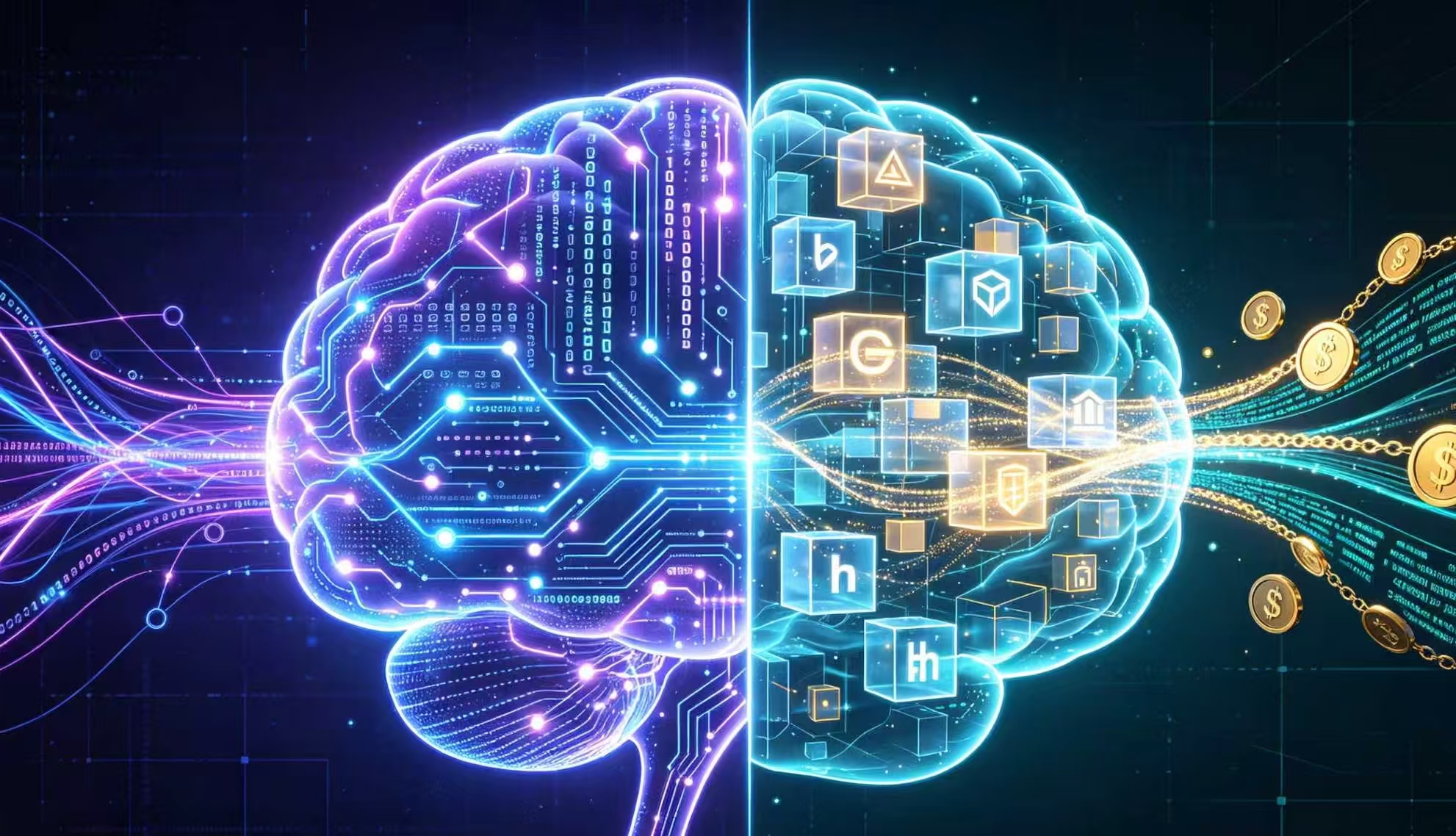
For years, artificial intelligence and blockchain have been treated as two separate, almost opposing technology megatrends. AI was about centralized computation, massive data ingestion, and opaque decision-making, while blockchain stood for decentralization, transparency, and verifiability. That narrative is now rapidly becoming outdated. A convergence is underway, driven by the recognition that the two technologies can compensate for each other’s most glaring weaknesses. Blockchain can provide the trust, traceability, and provenance layers that AI desperately needs as it penet deeper into critical societal functions, while AI can introduce a new level of autonomous intelligence and adaptability to blockchain-based systems. The result is a burgeoning new sector known as decentralized AI or crypto-AI.
The most immediately apparent intersection lies in compute infrastructure. Training state-of-the-art AI models demands enormous amounts of GPU power, a resource that has become scarce and centralized under a handful of cloud providers. Decentralized compute marketplaces like Akash Network, io.net, and Gensyn aim to aggregate underutilized GPU and CPU capacity from data centers, mining farms, and individual contributors around the world, offering it to AI researchers at a fraction of the cost of traditional cloud services. These platforms rely on blockchain for coordination, payment in crypto, and—critically—verification of the computational work performed. After all, if you are renting a stranger’s GPU to train your model, you need cryptographic assurance that the computations were actually executed correctly.
This need for verifiability is where the convergence goes much deeper. Zero-knowledge proofs and other cryptographic techniques can be used to generate proofs of correct inference or training steps. For example, a zkML (zero-knowledge machine learning) framework can allow a user to query an AI model and receive not just the output, but a proof that the model was run unmodified and without tampering, without revealing the model’s internal weights or the user’s private input data. This opens the door to privacy-preserving AI services in healthcare, finance, and legal domains, where sensitive data can be analyzed by a powerful model without ever leaving the user’s control or being exposed to the model provider.
On the data side, blockchain-based systems can also address the provenance and authenticity crisis brought on by generative AI. As AI-generated images, videos, and text flood the internet, the ability to cryptographically sign and time-stamp original content at the point of creation becomes critical. Decentralized identity protocols can link content to a verifiable creator, while content authenticity platforms like the Coalition for Content Provenance and Authenticity (C2PA) standard can be integrated with blockchain registries to immutably record the lineage of a piece of media. This does not magically solve the deepfake problem, but it creates an infrastructure where verifiable authenticity can coexist alongside synthetic content.
Another compelling frontier is the emergence of AI agents that transact and operate on-chain. These autonomous agents can manage crypto wallets, execute complex DeFi strategies, trade on decentralized exchanges, and even participate in DAO governance—all driven by machine learning models that react to real-time market data and on-chain events. This introduces a new paradigm where AI is not just a tool for analysis, but an active economic participant. It also raises profound questions about accountability, regulation, and the potential for autonomous financial systems to behave in unexpected ways during market stress. Several projects are building frameworks for verifiable agent execution, ensuring that an agent’s decision-making logic is auditable and its behavior can be constrained by on-chain rules.
The fusion of AI and blockchain is not without its skeptics. The computational overhead of many cryptographic verification techniques makes them impractical for extremely large neural networks at present, though rapid progress in proof systems is steadily closing the gap. The cost and latency of on-chain operations remain obstacles for AI agents that require microsecond-level reaction times. And then there is the ever-present challenge of user experience: interacting with decentralized AI infrastructure should feel as seamless as using a centralized app, a bar that the industry has yet to meet.
Nevertheless, the direction of travel is clear. AI is becoming the most intellectually significant technology of our time, and as it becomes further embedded in the fabric of society, the demand for verifiability, transparency, and user sovereignty over data and computation will only intensify. Blockchain provides the toolbox to meet that demand. The result is not a winner-takes-all scenario where one technology absorbs the other, but a deeply intertwined relationship where each makes the other more trustworthy and more useful. For anyone building or investing in the digital future, the AI-blockchain convergence is no longer a theoretical discussion—it is one of the most concrete and urgent arenas of innovation unfolding right now.