

The word “blockchain” is often thrown around alongside jargon like cryptocurrencies, NFTs, and DeFi, making it sound like a complex digital casino accessible only to tech insiders. In reality, blockchain is fundamentally a simple idea with profound implications: a way for people who do not know or trust each other to share a single, tamper-proof record of information without relying on a central authority. Understanding this foundation is not just for engineers or investors—it is becoming a basic literacy for anyone living in a digitizing world.
Imagine a shared notebook that everyone in a group can write in, but no one can erase a page. Every time someone writes a new entry, the page is numbered, dated, and linked to the previous page, forming a chain of pages. Before a new page is accepted, the majority of the group must agree that the entry is valid. Once it is added, it is permanently visible to everyone. This, in essence, is a blockchain: a distributed, append-only ledger where data is grouped into “blocks,” cryptographically linked to form an immutable “chain.”
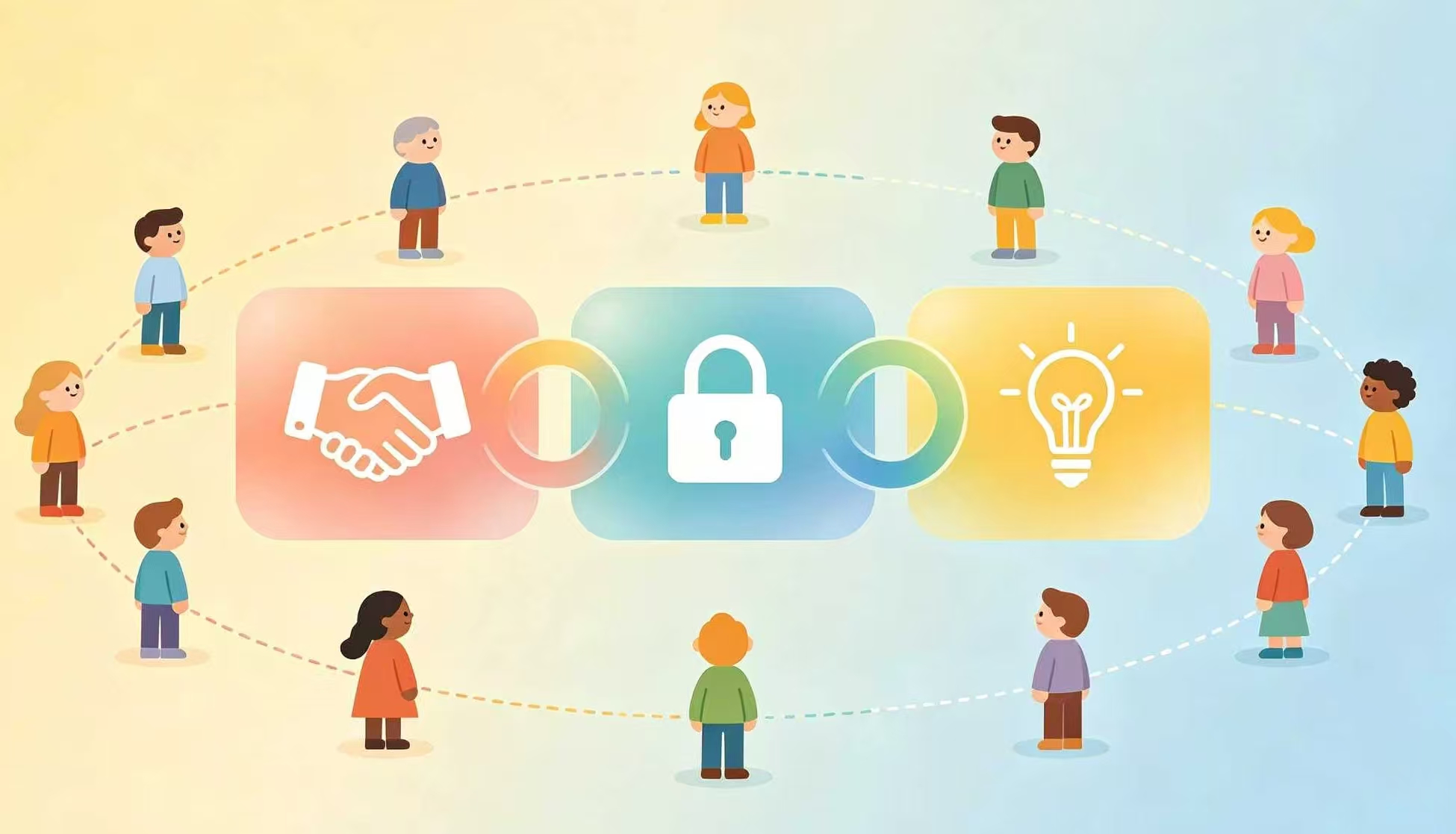
The mechanics are built on three pillars: decentralization, transparency, and cryptographic security. Decentralization means there is no single computer or company that controls the ledger. Instead, copies are held by thousands of independent nodes scattered around the globe. To alter a record, you would need to change more than half of those copies simultaneously—a task so computationally and economically impractical that it is considered effectively impossible. Transparency means all transactions are visible to anyone who cares to look, though the identities behind them can be pseudonymous. Cryptographic security ensures that once data is written, it cannot be altered without invalidating every subsequent block, an act that would be immediately detected by the network.
These properties solve a problem that has plagued humanity for millennia: the need for trusted third parties in exchanges of value and information. When you send money through a bank, the bank verifies that you have the funds and that you are not spending them twice. With blockchain, a distributed network of strangers performs this verification through consensus mechanisms like proof-of-work or proof-of-stake, removing the middleman and reducing costs. This is why blockchain was first popularized by Bitcoin—a currency that allows peer-to-peer transactions without a central bank. But the technology’s potential reaches far beyond money.
Supply chains are being transformed by blockchain. A mango sold in a European supermarket can be tracked from a specific farm in Ecuador, with every step of its journey recorded immutably. If a contamination outbreak occurs, the exact source can be identified in seconds rather than days. Digital identity is another frontier. Imagine a world where you control a single, verified digital identity that you can use to open bank accounts, vote, and prove your qualifications without repeatedly submitting paper documents to dozens of different organizations—and without a single company owning your data.
The creative and cultural sectors have also been reshaped. Artists can register their works on a blockchain, creating an unbreakable provenance trail that certifies authenticity and ownership. Musicians can release songs that pay royalties directly to them via smart contracts, cutting out layers of intermediaries. These use cases share a common thread: they empower individuals by giving them verifiable ownership and control over their digital and physical assets.
Perhaps the most inspiring aspect of blockchain is its potential for financial inclusion. According to the World Bank, around 1.4 billion adults remain unbanked. Many of them have access to a mobile phone but lack the official documents required by traditional banks. With a blockchain-based identity and a digital wallet, they could store value, send remittances, and access micro-loans without needing a passport or a credit history. This is already happening in pilot programs across sub-Saharan Africa and Southeast Asia, where stablecoins pegged to the dollar provide a hedge against local currency inflation.
Of course, blockchain is not a magic wand. Scalability, energy consumption (in proof-of-work systems), and user experience remain significant challenges. The technology is still in its early stages, often compared to the internet in the mid-1990s: clunky, misunderstood, and full of experimentation. Scams and speculation have marred its reputation. However, the underlying innovation—a shared, tamper-proof record maintained by a decentralized network—is steadily being integrated into the infrastructure of finance, logistics, healthcare, and governance.
Learning about blockchain today is like learning about email in 1995. It may not seem essential now, but it is quietly becoming the backbone of tomorrow’s digital society. The promise is not just faster transactions or new investment products, but a fundamental shift in how trust is established and maintained between strangers. In an era of deepfakes, data breaches, and eroding faith in institutions, a technology that allows anyone to verify truth independently is more than an innovation; it is a tool for building a more transparent and accountable world.